THE CJM IS TEMPORARILY CLOSED. SUPPORT US DURING OUR TRANSITION, SIGN UP FOR UPDATES, OR RENT THE MUSEUM FOR YOUR EVENT

By The CJM Education Staff

All you ever wanted to know about Torah (and more.) This document, prepared in conjunction with the exhibition As It Is Written: Project 304,805, on view Oct 8, 2009–Mar 29, 2011 at The Contemporary Jewish Museum, San Francisco, explores the role of Torah as a source text (content), as a material object (how it is created), as a ritual object (the function in most Jewish congregations), and as a muse (as a source from which law and stories and history have been created for centuries.) 

To view the other two parts of this series, or to download all three parts as a single, printable document, click below.

hebrew alphabet

In the Jewish tradition, letters are not mere signs, but are substantial participants in the story they create.

—Daniel Libeskind


The Hebrew alphabet is much more than a series of letters that are put together to form words. Each of the twenty-two letters is rich with significance, symbolism, and history. In the kabbalistic tradition, the ancient Hebrew alphabet is a spiritual tool full of hidden meaning and harmony. Within this mystical aspect of Judaism, each letter has a body, a soul, a spirit. The letters reflect values and morals, and can provide direction; their multiple layers of interpretation inspire inquiry, reflection, and study.

Like most early Semitic alphabetic systems, the Hebrew alphabet has no vowels. People who are fluent in the language do not need vowels to read Hebrew, and most Hebrew texts in Israel are written without vowels. Hebrew is read from right to left.


kabbalah

Kabbalah, translated as “that which is received,” is the mystical theology of the Jewish people. Practitioners of this school of thought read the Torah on the deepest level. Every word—indeed, every letter—has many levels of secret interpretation. For example, in the kabbalistic interpretation of Genesis, it is believed that God had to contract to make room for the creation of the universe, and as a result of the contraction, there was a shattering of vessels. The act of symbolically repairing these vessels is called Tikkun Olam, translated literally as “repairing (or correcting) the world.”

Like most of the commentaries surrounding the Torah, kabbalistic texts were once part of an ongoing oral tradition, although over the centuries many of them have been compiled into books and commentaries. The most important book to Jewish mystics is the Zohar, which means brilliance or splendor. It is a multivolume compilation of mystical commentaries on the Torah that first appeared in Spain during the thirteenth century.

the script

The Hebrew alphabet of twenty-two letters can be written in a variety of scripts. The laws governing the writing of a Torah Scroll dictate that it must be written in a special script that is consistent throughout. Another distinction is that the Torah Scroll is written without vowels or cantillation marks. The particular script that is used is a square Hebrew script evolved from early Aramaic calligraphy called K’tav Ashurit. The main types in use today are Beyt Yosef (Ashkenazi), Veilish (Sephardic), and Beyt Ariz”al. While greater variations in these calligraphic styles existed a few hundred years ago, today there is greater standardization among Torah Scrolls, allowing them to be read by anyone.

There are many rules governing the formation of each letter. The guidelines for writing the letter samech, for example, are detailed below.
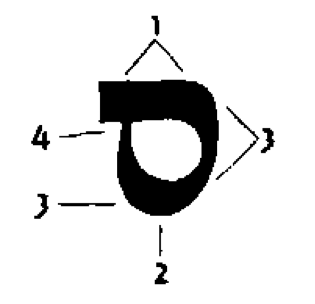
1. Its roof above should initially be long.

2. On the bottom, there should be a short base.

3. All three corners should be rounded and it should be completely closed at the roof. 

4. Its roof should initially extend outside to the left side for the length of the letter vav

SCRIBAL QUIRKS AND ODDITIES

When reading from the scroll, it quickly becomes apparent that there are several scribal quirks or oddities in the writing of a Torah Scroll that continue to be passed down. Certain letters are larger or smaller than standard size, other letters are given embellishments, and some passages are written in a columnar format that differs from the rest of the text. There is no agreed-upon explanation for these oddities. While they may speak to deep, hidden meanings embedded in the text, they also may be simply a codification of unique moments that occurred in the writing of the text centuries ago. For whatever reason they originally appeared, they have been perpetuated through the scribe’s careful copying and are recorded in the tikkun (correction guide). Here are three examples of the best-known quirks and oddities.


“JUSTIFYING” THE TEXT

When you look at any page of Torah you may notice that many of the letters at the ends of lines are stretched. This is because all the lines of the Torah need to begin and end at the same point, and if the scribe does not properly space out the line and has too much extra room at the end, they must elongate the remaining letters. Elongated letters appear most often at the end of a word, although they can also be found within a word. Think of it as the earliest form of “justifying” the text. 


song of the sea

The “Song of the Sea” (Exodus 15:1–19), which describes the parting of the Sea of Reeds, is written in three interlocking columns. The two outer columns symbolize the sea parted on either side, with the middle column representing the children of Israel marching on dry ground. Such format changes were instituted by the Masoretes—scribes of the seventh through ninth centuries who standardized the biblical text—to highlight the importance of certain passages by visually setting them apart from the rest of the text. All of the writing, including aspects of the layout such as this, must be done exactly to specifications in order for the scroll to be kosher. 


crowns

There are seven letters of the Hebrew alphabet that receive special treatment in a Torah Scroll.

All are embellished with taggin, which are the decorative crown-like flourishes added by a scribe on the upper left-hand corner of the letters. Taggin are found on the letters in tefillin and mezuzah scrolls, but never in any other handwritten scrolls or books. A tag is generally composed of three flourishes or strokes, each resembling a small version of the Hebrew letter zayin. The center stroke is slightly higher than the two end ones.

The origins and the meaning of these embellishments are not known. The Talmud comments that the taggin were in place when the Torah was transmitted to Moses at Sinai: it vividly describes Moses ascending to find God engaged in affixing taggin to the letters of the Torah. “When Moses went up to God, he found God sitting and putting little crowns on the top of the letters of the Law. He said to God, ‘Who is it that forces You to put crowns to the letters of the Law?’ He replied, ‘A man is to appear on earth after many generations, Akiba ben Joseph, who will expound for each top of every letter of the Law heaps and heaps of rulings.’”

And indeed, the meaning of taggin continues to inspire many interpretations, ranging from the observation that their shape resembles a dagger to protect the Torah, to the theory that they are purely decorative additions to enhance the beauty of the Torah.

For thousands of years, the technology has remained the same. It begins with parchment, ink, a hand-sharpened feather quill, and a scribe who states out loud the intention to write a Torah scroll, the most important object in the Jewish faith. Sixty-two sheets, 248 columns, 10,416 lines, 304,805 letters later, it is written.

WOMEN AND THE SCRIBAL TRADITION

Throughout history, commentaries have been written about the role of women in the production of scribal arts. While women are widely acknowledged as scribes for ketubot (the plural for ketubah—wedding contracts) and the decorative writing of scriptures, they have traditionally been forbidden from becoming sofrei STaM, scribes who are trained to write Torah Scrolls, tefillin, and mezuzot (the plural for mezuzah). Talmudic literature has connected the obligation to study Torah with the writing of the scroll: “Whosoever cannot serve as the representative of the public in religious matters is not permitted to write a scroll of the Torah” (Soferim 1:13). Until modern times, women have been excluded from reading the Torah in public, and therefore excluded from writing a Torah as well.

Today, there is growing recognition that women do study Torah in public and serve as rabbis, and so there is increasing support for permitting women to write a Torah Scroll. Professor Alan Cooper, provost of the Jewish Theological Seminary, has reflected: “a female scribe (soferet) signifies a natural evolution that is consonant with many other forward shifts in our culture and religious community. There used to be a lot of religious obligations exclusive to men, but just as women can now be rabbis, things change. Not only is Jewish law subject to interpretation for contemporary context, it is an inevitable process.” While Orthodox men make up the majority of scribes today, the corps of female scribes is growing.

CORRECTIONS AND PROOFREADING

For a scroll to be kosher, fit for ritual use, it cannot contain any errors. All 304,805 letters must be correct. A common misconception is that scribes are not permitted to make mistakes. Writing a Torah Scroll is extremely difficult, and no matter what precautions are taken, mistakes are inevitable, which is why a process has evolved over time to ensure that all mistakes are corrected. There are rules governing how to make corrections. For example, letters cannot be corrected by erasing part of one to form another. There are also complicated rules that govern corrections to certain words, the name of God being most critical.

To correct a mistake, the scribe painstakingly scrapes dried ink off the parchment, and then removes the rest of the ink residue with an architectural eraser. Finally, the scribe applies chalk to the spot to restore the color and then makes the correction.

Although the scribe is constantly checking and rechecking the text for mistakes, there also must be an additional proofreader. It is considered a good deed (mitzvah) to proofread a Torah, and any member of the Jewish community who speaks and reads Hebrew can perform this function, which consists of comparing the newly created text to the tikkun in order to locate mistakes for the scribe to correct.

DRESSING THE TORAH

The Torah mantle, which could be interpreted as symbolic of the High Priest’s tunic, is considered the “clothing” of the Torah scroll. The mantle is often made of velvet or other costly material, with intricately embroidered designs and dedicatory inscriptions. Torah Scrolls are often dressed in different mantles for specific holidays. For example, for the High Holidays—Rosh Hoshana and Yom Kippur—Torahs are often dressed in white mantles; green is frequently used for harvest holidays.

The breastplate or torah shield is an ornamental metal plate or shield hung around the “neck” of the Torah Scroll, often considered a reference to the breastplate worn by the High Priest when he ministered in the Temple in Jerusalem. Breastplates are found in all Ashkenazi communities, as well as in Italy and Turkey, but they have very distinctive designs in each community. Its more practical function is to designate which scroll is to be used for the Torah reading with interchangeable plaques.

Just as the High Priest during ancient times wore a miter on his head, and in reference to the regal nature of the Torah, the Torah wears either a crown, which covers the two wooden rollers to which the scroll is attached, or two finials, referred to by the Hebrew name for apple (tappu’ach) or pomegranate (rimmon). Traditionally, the decorative Torah crown was made from diverse items such as plants or jewelry. Crowns have evolved over time, and are now typically made of silver. The crown and finials are often decorated with small bells that emit a jingling sound when the Torah is carried through the congregation. So, too, the robe of the High Priest had small bells sewn around its hem so that people could hear him as he moved about the sanctuary in performance of his duties in the ancient Tabernacle.

The parchment scroll must not be touched, both because of its sanctity and because the oils from people’s hands can damage the delicate writing. Therefore, a pointer called a yad (the Hebrew word for hand or finger) is used. The Torah pointer, shaped like a right hand with a finger pointing, is also used to help the reader keep his or her place while reading from the scroll.

In many Sephardic (Eastern Jewish) communities, the Torah is not covered with a mantle; rather, it is stored directly in a case—a small wooden or metal cabinet that is either round or prism shaped. The shape and ornamentation of the case varies depending on the region. In Yemen, eastern Iran, and Afghanistan, a flat-topped case was most often used, while a circular crown was used in Babylonian communities such as Iraq and western Iran. Many Torah cases bear colorful drawn images, while others are adorned with leather, silver plates, or different fabrics, like the ones on view here. Inscriptions are often found around the edges, front, or sides, conveying either information about the donor or biblical verses celebrating the Torah. During the service, the cases are taken from the ark and placed upright on the reader’s table.

The Torah binder is often symbolically linked to the sash worn by the High Priest in ancient times. This long swatch of linen is used to literally bind the Torah scroll before the mantle is placed over it, holding the scroll tightly rolled and protecting it when it is being held or standing in the ark. In the German tradition, the Torah binder, known as a wimpel in old German, was fashioned from a piece of the swaddling cloth used to wrap a male infant during his circumcision ceremony. The infant’s name, his father’s name, and his date of birth, as well as the blessing recited during the ceremony, were embroidered or written on the cloth.

the torah ark

In every synagogue, the centerpiece of the sanctuary is the Aron HaKodesh, or Holy Ark, where the torah scrolls are housed. Because the ark holds the Torah, it is the main focus of all activity in a synagogue, and is thus typically the most ornate object in the synagogue’s sanctuary. Many synagogue arks are dramatic works of art or craftsmanship in wood or metal, filled with symbolic elements representing parts of the Jewish tradition. Most arks feature a parokhet (curtain), which can be placed either inside or outside the doors of the ark. In the sanctuary, the Torah ark is always positioned on the wall that is either closest to or facing in the direction of Jerusalem and all of the seats face the ark.

The name Aron HaKodesh is derived from the Ark of the Covenant in the ancient Tabernacle of the Temple in Jerusalem. The Ark of the Covenant is a container described in the Bible as containing the tablets of stone on which were inscribed the Ten Commandments, evidence of God’s covenant with the people. When the doors or curtains of the ark in a synagogue are opened, revealing the Torahs, the entire congregation stands in adoration of the Torah scroll within it, referencing how the Israelites stood at the base on Mount Sinai for the revelation of the Torah.

Image Credit

Header image and photos: Installation views of As it is Written: Project 304, 805. On view October 8, 2009–March 29, 2011 at The Contemporary Jewish Museum, San Francisco. Photo credit: Ben Blackwell.